Spiral Up: Chase Gomez on Long-Distance Caregiving and How to Start the Conversation.
Chaston Gomez sat down with the Foundation for Women’s Cancer to share his story on June 30th, 2026. The day after the one-year anniversary of losing his mother. He didn’t have to mention it. He chose to so that he can continue to process his grief.
“Yesterday was the one year for [my mother’s] passing. So excuse me if I get a little emotional talking about it, but, you know, my bereavement counselor said what I’m doing right now is actually really therapeutic.”
— Chase Gomez
That willingness to speak, even on the hardest days, is the foundation of everything Chase has built since his mother’s diagnosis: a caregiver’s toolkit born out of love, grief, and a determination to make sure other families don’t feel as unprepared as his did.
A Relationship Built on Small Things
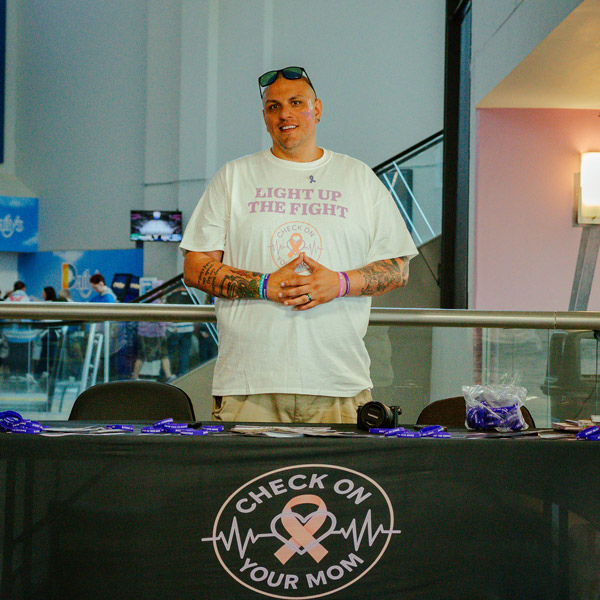
Chaston, who goes by Chase rather than his full name Chaston, is a content creator, drone pilot, and photographer based in Jacksonville, Florida, and a father to three daughters, ages 20, 8, and 4. He describes his relationship with his mother, Sherina, before cancer entered the picture, as simply normal: a mother who was always telling her son to go to the doctor, never the other way around.
Their bond was built on small, ordinary things, her love of couponing, family recipes, inside jokes. Chase still catches himself comparing unit prices in the grocery store because of her, a habit he’s now passing down to his own daughters. On her deathbed, he asked her where in the world, she’d always wanted to go. Her answer was simple: Maine. He’s planning the trip now.
Becoming the Parent
Chase’s mom, Sherina, was diagnosed with endometrial cancer in April of 2024. She lived in Galesburg, Illinois, a small town roughly 45 minutes from her cancer doctor in Peoria. Chase was over a thousand miles away in Jacksonville. The distance didn’t stop him from showing up, starting with the moment that everything changed.
“I drove up there after her hysterectomy. She didn’t even know I was coming… I call[ed] her, she didn’t answer. I [went] inside and she’s just laying there. She’s got an ice pack on her stomach. That’s kind of where the communication really started, because I put forth that effort right from the get-go.”
— Chase Gomez
From there, Chase became part of a caregiving team stitched together across states: his father was, in Chase’s words, “the boots on the ground.” His aunt, who has a background in the insurance industry and knew the medical terminology Chase didn’t was instrumental in his mom’s caregiving team. Chase’s role became long-distance coordination: constant FaceTimes, texts, and calls, tracking appointments, symptoms, and medication schedules from hundreds of miles away.
“She was forgetting that she was either not taking her medicine or was taking her medicine. So I would call her on her schedule and stay on the line with her, FaceTiming, and make sure she physically took it. Show me your mouth. I need to see. And then I had a little journal, I would write it in. What’s your pain level at? Are you nauseated? When was the last time you had something to drink?”
— Chase Gomez
He taught himself the vocabulary of Sherina’s diagnosis mostly through Google, sounding out unfamiliar words like “endometrial” for the first time on camera, mistakes and all. It was, in his own words, hectic. It was also, without hesitation, worth every bit of it.
When Sherina’s hair began falling out in clumps, Chase shaved his own head so she wouldn’t feel alone in the change. He still shaves it today, for the other patients he’s met along the way. Somewhere in the middle of learning medical terms, tracking symptoms, and becoming the family’s central point of contact, Chase realized he wasn’t just supporting Sherina anymore. He was parenting her, and, in different ways, parenting his father too, keeping him organized through a process neither of them had faced before.
Parenting Two Generations at Once
While Chase was learning to care for Sherina, he was also raising three daughters of his own: a daughter now 20, an eight-year-old, and a four-year-old. Each of them experienced their grandmother’s illness differently.
His eight-year-old came with him on trips to see her grandmother in the hospital, visiting often, until Chase made the difficult call to shield her from the final days.
“She would come and see grandma, you know, every day, every other day, until it got towards the end. And then I was like, no, you don’t need to see this. [I] had to do that parental barrier, like, look, this is not how you want to remember her.”
— Chase Gomez
Sherina loved purple butterflies, and now his eight-year-old does too. She gave Chase a small purple butterfly pen, which he uses whenever he signs anything important. His four-year-old understands only that grandma is gone, and asks questions, and Chase answers as best he can. His oldest daughter, who lived closest to her grandmother and shared everyday moments with her, cooking, baking, shopping, was hit the hardest of all, grieving not just her grandmother but the future memories that wouldn’t happen.
Chase was simultaneously the son learning to parent Sherina through illness, a support system for his father, and a father himself, trying to help three children of very different ages understand loss in ways they could each carry.
“I hate cancer so much, man, so much… Almost, you know, part of me almost thinks that I do all this stuff out of spite and vengeance towards cancer. It’s a revenge tour for me. When she passed, most people say the cancer killed her. I said, no. It ended in a tie, because when she died, the cancer died with her.”
— Chase Gomez
Why Men Need to Have This Conversation
Chase is candid about something many families avoid: for most of their lives, he and Sherina never discussed her body or her health directly. It simply wasn’t something they talked about, until her diagnosis forced the conversation into the open.
“My mom and I, we didn’t talk about her body situation, and that’s one of the stigmas I am working to destroy and get men more involved. Talk about it. If it’s weird, it’s weird. But when you do something enough times, that weirdness becomes normal. So if you just start that conversation, ask questions, and really pry, because you’re going to have to at first.”
— Chase Gomez
He’s clear that this doesn’t come naturally, even now. He and his wife have been together 16 years, and he says he still has to draw answers out of her. For Chase, discomfort isn’t a reason to stay quiet. It’s the whole point. He offers a simple entry point for men who don’t know where to start.
“I would suggest straightforward. Just, hey, how are you really feeling? It sounds so simple, but if someone asked you, hey, how are you feeling, what’s your initial response going to be? I’m fine. [Go deeper, ask] No, seriously, how are you feeling? Is there anything going on? Have you been feeling any kind of pain or discomfort? Maybe we should set something up with a doctor. It’s the little things.”
— Chase Gomez
Chase’s openness has changed how his own family talks about health. His 20-year-old daughter, who had a son of her own last year, is now, in Chase’s words, completely comfortable discussing these topics, a shift he credits directly to modeling the conversation himself. His encouragement has since extended well past his own household.
“It’s gotten so normal for me to talk to women about it that I just talk to them. It doesn’t have to be within my family anymore. I could be talking to the lady at the register. Hey, how’s it going? Have you been to the doctor lately? You have no idea how many times I get stopped and hear, hey, you’re that guy, and because of you, I started talking to my mom, and she goes to appointments now.”
— Chase Gomez
Check on Your Mom
Check on Your Mom began, quite literally, as a way for Chase to help his own father stay organized during Sherina’s treatment. Chase, who has a background in digital and affiliate marketing, built simple resources and trackers for his dad. When he saw how much it helped, he realized the same tools could help other families too.
The name reflects where it started, but Chase has watched its meaning grow well beyond his own household.
“Check on your mom was based on that slogan, how it became check on your mom was just because of what I was going through. But as it evolved, it became, well, check on your spouse, your sister, your aunt, and your daughters. It doesn’t have to be just your mom.”
— Chase Gomez
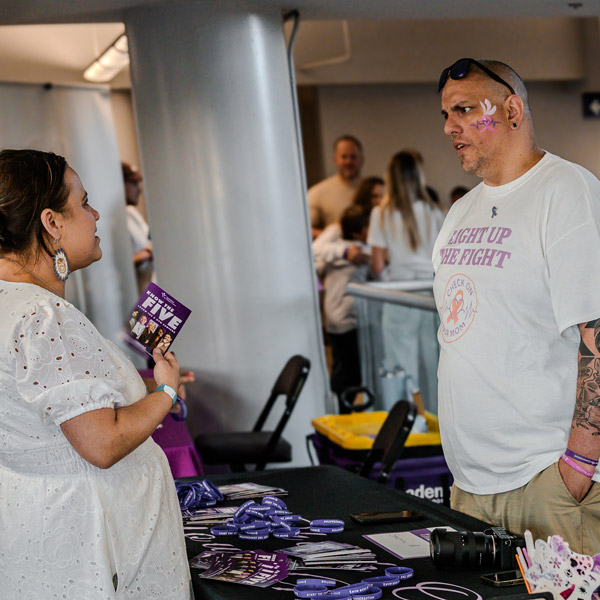
Chase has taken that message on the road, tabling at community events across Jacksonville, from a local creators’ meetup to a University of North Florida women’s basketball game, where he personally pressed 250 rally towels to hand out alongside the Foundation for Women’s Cancer’s fast fact cards. He sees his role as a bridge: starting the conversation himself, then pointing people toward the medical resources and organizations equipped to answer the deeper questions.
Chase also shared news with us that hasn’t been made public yet: Check on Your Mom is partnering with a University of North Florida software engineering professor, whose students will build out a caregiver app system Chase has already begun designing himself.
“Check on Your Mom is partnering with a professor from UNF for software engineering. Their students are going to take on a project for Check on Your Mom to build a caregiver app system. I’ve already built part of it myself. Family members can stay connected by what’s going on, on the ground, far away: appointments, pain, nausea, all of this stuff.”
— Chase Gomez
Chase has also been in talks with Community Hospice in Jacksonville, which has expressed interest in piloting the app with the families it serves once it’s fully built. He says the goal is to give long-distance caregivers like himself the kind of shared, real-time visibility his own family had to build by hand, one FaceTime call and one handwritten journal entry at a time.
It’s part of a broader slate of plans still taking shape: a charity golf tournament, a community walk Chase is calling “Walk and Talks,” designed to get families moving and talking together, and continued partnerships with local sports teams and community organizations across Jacksonville.
Choosing to Spiral Up
Sherina was known in her community for her generosity, regularly donating coupon-discounted goods to schools and food pantries. In 2016, she was honored with a local Pay It Forward award for that work. In 2025, without knowing Sherina had once won the same recognition for the same kind of community giving, Chase was honored with a Pay It Forward award of his own, two generations of the same family, recognized for the same spirit of service.
When Sherina passed, Chase offered his father and brother a piece of perspective that now guides his own mission.
“When she passed, I told my dad and my brother, I was like, you have a choice. You can either let this be your reason to spiral out or this be the reason to spiral up. So, what are you going to do? I seriously live by that. And I chose the spiral up. I want to help others impact the world in a positive way.”
— Chase Gomez
That philosophy runs through everything Chase is building, from the trackers he first made for his father, to the caregiver app now in development, to the conversations he keeps starting with strangers, friends, and family. His hope is simple: that his voice can be the nudge someone needs to check on the people they love, before it’s too late to ask.
“If my voice could be that nudge where they saved their mom’s life because they advocated to go to a doctor, their daughter’s life because she noticed something wasn’t right, or even your wife, it trickles down. And if we can continue talking about it, no one will forget.”
— Chase Gomez
One year after losing his mom, Chase Gomez is still learning to live in the space between grief and purpose. He carries her with him, literally, in a necklace containing her ashes, and figuratively, in every conversation he starts on her behalf. Her legacy, and his, is simple: check on your mom. Check on your spouse. Check on your sister. Check on your daughter, and don’t stop asking questions until you get a real answer.