It Started With a Cough: Faith Kilango’s Journey Through Gestational Trophoblastic Disease
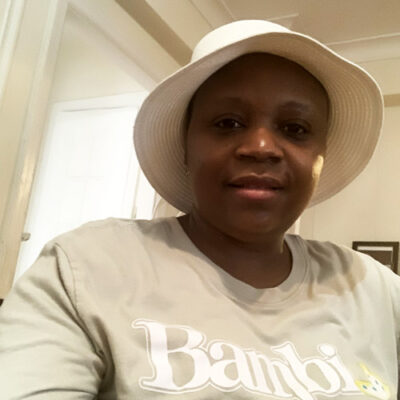
Faith Kilango
It all started with a cough, a persistent, nagging cough that began while Faith Kilango was visiting her family in Kenya, her home country in East Africa. Faith and her family had traveled there, as she and her family do every year, to reconnect with loved ones and soak in the warmth of her motherland. Within weeks, what started as a minor irritation during afternoon gardening sessions would force her to cut her trip short and return to the United States. That cough would ultimately lead to one of the most life-altering diagnoses of her life.
Faith, a caregiver who works with special needs children, a devoted wife, and mother of two daughters now ages 10 and 7, had no reason to suspect what was quietly developing inside her body. She was active, diligent about her health, and proactive about her annual screenings. Cancer, especially a rare form most people have never heard of, was simply not on her radar.
The Cough That Changed Her Life
During her three-month trip to Kenya, Faith found herself gardening, visiting family, and enjoying the kind of physical activity that her life in the United States didn’t always allow; long walks, climbing hills, tending to her farm. It was during this that her persistent cough began. At first, it seemed harmless.
“We started joking about it, saying, ‘How could a cough affect me now while I’m back home?’ But it went from a mild cough to a very aggressive one. I was constantly coughing. It was so weird.”
— Faith Kilango
Within two weeks, the cough became violent and relentless, lasting up to five minutes at a time without stopping, eventually producing blood. Something she and her family knew was seriously wrong. They cut their trip short and returned home to get answers.
However, the journey to a diagnosis wasn’t simple. One doctor led to another. Each specialist pointed her further down a winding path until she finally landed in the office of Dr. Andrea Hagemann. It was there that Faith received the news: she had a rare form of Uterine Cancer called Gestational Trophoblastic Disease. It was already at Stage 4 and had spread to her lungs.
“I don’t know when it became stage one,” Faith recalled. “It was really shocking.”
What is Gestational Trophoblastic Disease (GTD)?
Gestational Trophoblastic Disease (GTD) is a rare group of tumors that develop from cells that would normally form the placenta during pregnancy. It includes several conditions, one of the most aggressive, being choriocarcinoma, which is Faith’s specific diagnosis.
GTD can affect any woman who has been pregnant, regardless of the outcome of that pregnancy. It doesn’t matter whether the pregnancy ended in a live birth, a miscarriage, molar pregnancy, or an ectopic pregnancy. As Faith explains it:
“It doesn’t matter whether you had a miscarriage, it doesn’t matter whether you had a molar pregnancy, or if you had an ectopic pregnancy. As long as you have been pregnant before, then you are at high risk of this cancer.”
— Faith Kilango
One of the most deceptive aspects of GTD is that its symptoms don’t always look the way you’d expect. Most people associate it with vaginal bleeding or pelvic complications. But Faith’s cancer had already spread to her lungs (affecting nearly two-thirds of her right lung), her brain, and her pelvis before anyone knew what they were looking for. Her uterus, counterintuitively, was never directly affected.
A key marker for GTD is elevated HCG (human chorionic gonadotropin), the hormone typically associated with pregnancy. In Faith’s case, her HCG levels were registering in the thousands, as if she were several months pregnant, despite not being pregnant at all.
The Weight of Telling Family
When Faith received her diagnosis, she was 37 years old, with a 4-year-old and a 7-year-old at home. The news was devastating but processing it herself was only part of the battle. Telling her family brought an entirely different kind of pressure.
Rather than rallying around her with strength, many of her loved ones broke down, leaving Faith in the unexpected position of consoling the very people she needed support from.
“They were crying. So instead of helping me forget about it, I was the one consoling them. [My family would say,] ‘Hey, you should not worry about this because it is treatable.’ Though we really didn’t know at that particular time how long it was going to take.”
— Faith Kilango
Back home in Kenya, the cultural misunderstandings compounded the grief. When Faith visited her parents, people questioned what she had “done wrong” to get cancer, linking her illness to contraceptive use and other misconceptions. She faced myths, misinformation, and the heavy burden of being the one who had to correct them, while still fighting for her own life.
Closer to home, there were practical fears too. Her husband had to take on everything; the cooking, the childcare, the caregiving all while continuing to work. Faith worried constantly about who would care for her young daughters, especially her youngest, who still needed help with basic tasks. She spent two weeks in a fog of fear, voices offering herbal remedies and unsolicited advice from all directions.
Then she made a decision.
“I’m going to fight. I’m not going to go down without a fight. Cancer chose me, and I’m not going to let it win. I had to decide to be strong for me, for my kids, for my family.”
— Faith Kilango
A Second Chance at the Small Things
Now 40 years old and in her third year of battling choriocarcinoma, Faith is still in treatment, but she is winning. She goes in once a month, pausing life for that week to focus entirely on herself, then resuming the rhythm of daily living in the weeks that follow.
What has changed most is how she sees the ordinary. Picking up her daughters from school. Sitting down to pray together as a family. Going out for a meal, just sheand her girls. These are the moments Faith once had to miss entirely, and she now holds them as treasures.
“I feel like it’s a second chance,” she says simply. “And I don’t complain. I give it my all.”
Her husband, who she says could have left when things were at their worst, chose to stay. Her doctor, Dr. Andrea Hagemann, has walked beside her every step of the way, connecting her with therapists, resources, and a team of nurses who made her feel seen. Faith is grateful for all of it, and she is determined to use her story to make sure other women don’t find out about GTD the hard way.
What Faith Wants You to Know
Faith’s message is clear, urgent, and personal: make your body a priority. GTD is aggressive and capable of multiplying from single digits to thousands of units within just two weeks. It doesn’t always announce itself with the signs you’d expect.
She encourages every woman, especially mothers, to go for regular blood work, check your HCG levels, and advocate for themselves at every appointment.
“You don’t have to feel sick for it to be there. Go get checked to make sure everything is normal, and go regularly. This cancer is very aggressive. It’s highly treatable, yes—but very aggressive.”
— Faith Kilango
She also speaks to the importance of raising awareness beyond the United States. When she returned to Kenya, people didn’t know what GTD was. They didn’t know cancer could look like a cough. They didn’t know that a mother who seemed healthy on the outside could be fighting for her life on the inside.
That’s why Faith keeps showing up. She’s walked in cancer awareness events, shared her story publicly for the first time, and now she’s almost ready to ring the bell.
When she does, it won’t just be for herself. It will be for every woman who hasn’t yet heard the word choriocarcinoma. For every mother who puts everyone else first. For every person who might have a cough they haven’t thought twice about.
If you or someone you love has been pregnant, at any time regardless of the outcome, and is experiencing unexplained symptoms, ask your doctor about GTD. Request blood work. Check your HCG levels.
Be your own advocate.
Because, Faith knows better than anyone: it all started with a simple cough.