Even Without Ovaries: Cheryl Scott’s Story of Ovarian Cancer, BRCA1, and the Power of Speaking Up
 Cheryl Scott had already done everything right. She knew her family history, had genetic testing, and made the hardest decisions of her life to protect herself before cancer ever had the chance to take spread.
Cheryl had her ovaries and fallopian tubes removed, and a prophylactic double mastectomy, the process that includes having both healthy breasts removed. For six years, she believed she had outrun the disease that took her mother and her sister.
Then, in December of 2022, a pain in her side told her otherwise.
Cheryl’s story is a reminder that being proactive about your health isn’t a single decision made once and then set aside. It’s a lifelong practice, one built on family history, honest conversations, and refusing to accept “standard medical processes.”
A Family History Written in Loss
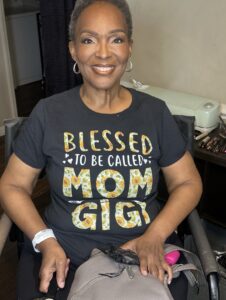
Cheryl grew up as “an Army brat,” moving around the world with her father, a 20-year military veteran. Today she’s Gigi to five grandchildren, and mother to a son and a daughter she describes as her greatest advocates. However, woven through her family’s story is a painful history of cancer. Her sister, Cynthia, died of breast cancer at just 41 years old, in 1999. Her mother of ovarian cancer in 1985. As a result, Cheryl underwent a partial hysterectomy.
To be closer to family, Cheryl relocated from Rochester, New York, to South Carolina in 2015. Due to her knowledge of her family history, Cheryl instinctively sought out a new set of doctors. It was her new gynecologist, Dr. Parson, who changed the course of her life at their very first appointment.
“[Doctor Parsons] said, ‘I don’t like your family history. I’d like to do genetic testing.’ So, I said, ‘okay, when do we schedule [the test]?’ She replied, ‘No, I’m going to walk you to the lab right now.’
— Cheryl Scott
That same-day trip to the lab would reveal a mutation that had already taken two of the women Cheryl loved most.
What Is BRCA1?
BRCA1 is a gene that, in its normal form, helps repair damaged DNA and suppress tumor growth. When it’s mutated, that protection breaks down, and the risk of certain cancers rises sharply. For Cheryl, her mutated BRAC1 gene results were stark: an 80% chance of developing breast cancer, and a 50% chance of developing ovarian cancer.
BRCA1 and BRCA2 mutations can be passed down through a family, regardless of gender, and they don’t only raise the risk of breast and ovarian cancer. They’re linked to other cancers as well, including prostate cancer in men. Anyone with a family history of breast, ovarian, or related cancers, especially cancers diagnosed at a young age, are a candidate for genetic testing.
Cheryl found out she was positive for BRCA1 in the most ordinary way imaginable: a certified letter, tucked into a note on her door while she was traveling. She said she already sensed what it would say.
“Sure enough, it said I tested positive for BRCA1…. [Doctor Parsons] said, ‘there’s no easy way for me to tell you this, you know, but you’re at high risk for both.’ The two things that took my mother and my sister, I now have the mutation for.”
— Cheryl Scott
Choosing to Act Before Cancer Could
Cheryl didn’t wait.
Because she had already had a hysterectomy, she moved quickly to have her ovaries and fallopian tubes removed in July of 2016. A little over a year later, in September of 2017, she underwent a prophylactic double mastectomy, a decision she calls one of the hardest of her life.
For a while, it felt like enough. Cheryl described the years that followed as a season of relief. Feeling that by removing the organs most at risk, she had removed the threat itself.
That sense of security was held until the spring of 2022.
When the Pain Came Back
In May of 2022, Cheryl began having pain on her right side and noticeably bloating. Because her ovaries were gone, ovarian cancer wasn’t on anyone’s radar, including her own. Doctors suspected of a gastrointestinal issue. She had an endoscopy and a colonoscopy. Both came back to normal. She was put on prednisone and an antibiotic, just in case, and the pain settled into the background of daily life.
Then came December 8th, a date she says she’ll never forget.
“I must have rolled on the tumor while I was sleeping. I literally leapt out of my bed screaming. I’ve had a C-section, I’ve had vaginal birth, nothing was anything like this pain.”
— Cheryl Scott
A CT scan found a tumor the size of a baseball. The next day, blood work showed her CA 125, a protein marker used to help detect gynecological cancers, at 118. Off the charts is 300. An MRI followed, revealing what she describes simply as “lots of tumors.”
On January 12, 2023, Cheryl went into surgery. Her oncologist had expected the procedure to take about five hours. It took seven and a half.
Surgeons found 27 tumors and had to remove her spleen, two sections of her liver, part of her diaphragm, and part of the sheath around her bladder. On the operating table, Cheryl went into atrial fibrillation and renal failure.
When she finally asked her oncologist how this was possible, given that she had no ovaries left to develop ovarian cancer, the answer reframed everything she thought she knew about her own risk.
“When you have your fallopian tubes and ovaries removed, there’s a possibility of random cells still being in the cavity… It took six years for those random cells to connect. There’s only 3 to 5% of women like me in the world, according to my oncologist. She’s never diagnosed anyone like me.”
— Cheryl Scott
It’s why Cheryl calls her own story a cautionary tale. After her surgeries, she stopped seeing a gynecologist altogether, because she felt that there was nothing left to check. Her doctor has since told her that this experience changed how she practices medicine; she no longer discharges patients who’ve had risk-reducing surgeries. She continues to see them, every year, for life.
“I still think, but I don’t have ovaries. This particular disease is wreaking havoc on me and I don’t have ovaries. It’s just mind-boggling.”
— Cheryl Scott
Starting the Family Conversation
When Cheryl received her diagnosis, she made a deliberate choice about how to tell her family. Her son was living in New York and her daughter in South Carolina; she wanted to make sure she told them at the same time.
After telling them about her diagnosis via Zoom, her son left the call in silence. Her mother had died when he was four, and his aunt Cynthia had been his favorite aunt. Cancer, to him, meant loss.
Cheryl waited until after the holidays to tell her wider family, not wanting to “ruin anyone’s Christmas.” When she finally called a family meeting, an event she says she had never called before, she watched relatives immediately reach for their phones to start researching, unable to believe what they were hearing.
For Cheryl, the diagnosis wasn’t just personal. It was generational, because BRCA1 is hereditary, she knew her children and extended family needed to understand their own risk.
“If you’re BRCA1, your offspring have a 50-50 chance of being BRCA1. So, I encouraged my daughter to be tested, and she does not have the gene mutation.”
— Cheryl Scott
Her daughter tested negatively, but her sister’s granddaughter, Cheryl’s great-niece, tested positive. Her son, who had long put off genetic testing for himself, is being tested this summer, prompted by the fact that he now has a young daughter of his own. Prostate cancer risk is also linked to BRCA mutations in men.
Cheryl sees these conversations as essential, especially in communities where illness has historically gone undiscussed. She remembers being told only that her grandmother’s cousin died of “female issues,” with no further explanation ever offered.
“I’m an advocate, but not just for ovarian cancer, just for healthcare, period. Ask the questions, keep pushing back.”
— Cheryl Scott
That advocacy runs in the family. When her other sister found a lump in her breast that turned out benign but still warranted a specialist, she credited Cheryl directly: because of what Cheryl had been through, she chose to have it removed rather than wait and watch.
Seizing the Day
Cheryl doesn’t keep a bucket list. She keeps what she calls a “seize the day” list, and sharing her story with the Foundation for Women’s Cancer was on it.
“Statistics are just that, and there are humans behind the statistics. I don’t fit any of the statistics, but here I am.”
— Cheryl Scott
She found her way to the Foundation through a friend involved with Teal Diva and later met Holly, who leads FWC’s Development initiatives at a walk in Charlotte, an event she describes as overwhelming in the best way; buses full of survivors, family members, and even physicians walking alongside their patients. It was there she first learned there might be a place for her story to reach the people who need it most, including the medical students and providers she now regularly speaks to.
“I would love to be able to talk to folks who go back to their own organizations, their lives, their practices. They go back and it just changes the way that they all look at patients.”
— Cheryl Scott
What Cheryl Wants You to Know
Cheryl’s message centers on one simple, repeatable action: ask for the exam, even when everything else has come back to normal.
“My first line that I tell everyone to ask now for is an ultrasound. It’s $80, whether you have to pay it out of your pocket or your insurance pays it… If not transvaginal, just say, can we just do one more exam, just to make sure it’s not just in my head. Humor me.”
— Cheryl Scott
She also wants families with a history of breast, ovarian, or related cancers to talk openly, and early, about genetic testing, even when the conversations are uncomfortable. A single test can change the course of a family’s future, as it has for Cheryl’s own great-niece, tested and prepared because of a conversation Cheryl was willing to start.
Removing her ovaries did not remove her risk entirely, and that is precisely why Cheryl keeps telling her story, because being proactive isn’t a box to check once. It’s a commitment to keep asking questions, keep showing up for appointments, and keep listening to your body, even after you think you’ve done everything right.
If you have a family history of breast, ovarian, or related cancers, talk to your doctor about genetic counseling and testing. Know your CA 125. Ask for the ultrasound and talk to your family, because as Cheryl’s story shows, that conversation can be the one that saves a life.